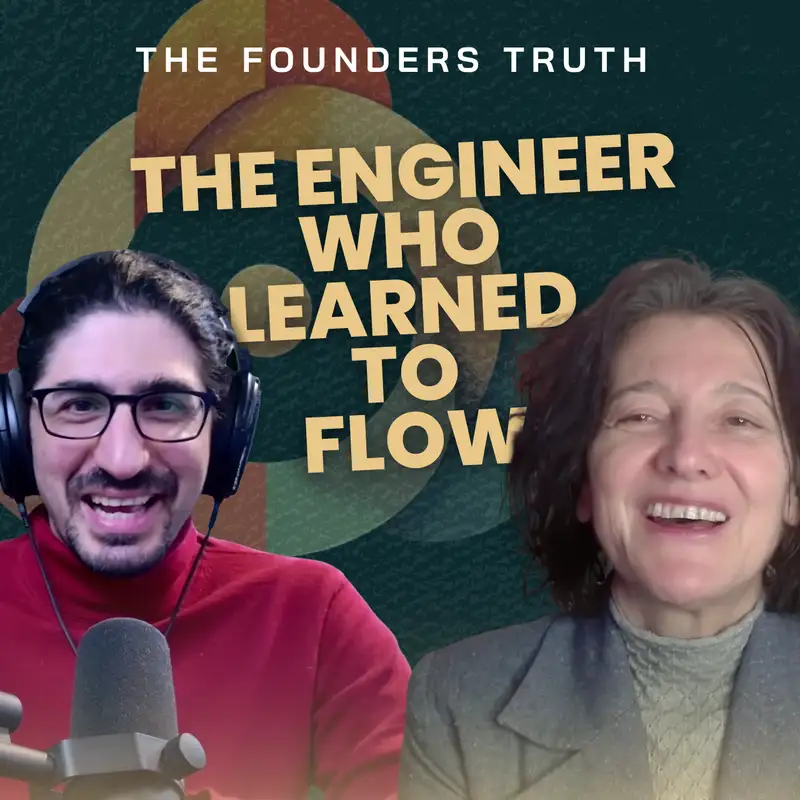
#09 The Energy You'll Get Back When You Stop Fitting the Mould with Cornelia Kawann
Hello, Unconventional Founders, and welcome to The Founders Truth, a conversation with Carlo Mahfouz and guests. Episode nine welcomes Doctor. Cornelia Kawann, electrical engineer, executive, and personal energy strategist, as we explore where founders ready Hemorrhage Energy, the missing ingredient in teams that actually trust each other and why authenticity makes the biggest difference.
Cornelia Kawann:Welcome to this podcast. I'm very excited. I'm Doctor. Cornelia Kawann. And I work with personal energy and energetic leadership, meaning how we lead, how we decide, communicate, and create results without burning ourselves out.
Cornelia Kawann:And today, I am speaking with Carlo Mahfouz, the author of Reopticec. And I had the chance to read this book, and yeah, in a way it's all about asking the right questions. And now you're working on a trilogy for Founders, and this book should be part of it, but we come to this later. And if I understand the concept, right, it's all about how you think we should think about leadership, culture, and the way we are building our world, and also how we integrate technology into that. So I'm really looking forward to this, Carlo, I'm happy to be here with you, yes.
Cornelia Kawann:And so starting with the first question, I would like to know, how is your energy today?
Carlo Mahfouz:Oh my God, my energy has been fluctuating all day between high and low and high again. So it's been a whirlwind and now it's quite high. I really loved your introduction and I'm excited to get this conversation going.
Cornelia Kawann:Yeah, me too. So, why was there like all these ups and downs? What happened?
Carlo Mahfouz:I think, you know, different type of conversations bring shift energy across the day, certain set of expectations that you either see coming or you don't see coming kind of play a role. And and you realize how fleeting most of the energy is that's in a certain way, how it comes in waves and changes. I'm usually back to back every day, so that today was no different. And every conversation brought a different type of dynamic, not necessarily in a positive or negative sense, but not with a different, I would say, enthusiasm and excitement, some build it up, some kind of diminished it. So it was really a little bit, yeah, as I said, a whirlwind, at least that's how I can feel it.
Carlo Mahfouz:It's like a wave kind of crashed and then a wave, a new wave is coming.
Cornelia Kawann:Wow, I think you described it very well. And actually, is, yeah, what I would like to dive in a little bit deeper. In a way, if you look at your first book, The Reality Check, right? And of course, it's asking about the right or the correct questions, but it's also about distractions in a way. And this, of course, distractions has a lot to do with our energy.
Cornelia Kawann:So, you know, now from your experience and from your work, what do you think are like these common energy leaks you see in founders?
Carlo Mahfouz:I think probably is a little bit the pressure that is put on them on a certain set of expectations on how they need to be and what the realities are and how they need to deliver against it. I think that is a major distraction and an energy leak on its own. I do believe the realities as they present themselves have a lot of opportunity, even if in the moment they do sound negative. And getting out of this stereotypical or kind of pre configured notion of what a founder should be, whether it's regarding, you know, it's the self made version, that's you against the world alone into this journey, or even what success looks like and how long does it take or how quick and fast and how efficient you need to be and all of these type of optimizations that honestly, 90% of the time lead to more burnout rather than actually be need to something more efficient and effective in the delivery. So I feel that kind of plays out on all of these factors more so and not.
Carlo Mahfouz:Yeah.
Cornelia Kawann:So, and what would you recommend how to deal with these energy leaks or how to mitigate them?
Carlo Mahfouz:I believe a great way is to not try to push them back in a way, but recognizing them as a first step. I think the part of recognition is always, it sounds a very simple thing, but I think it has a lot of ramifications down the line and understanding that that's something impacting you, that that's something holding you from a bias or from a validation or a judgment, reconceived judgment. I think understanding that relationship you have with these, if you want, thoughts or mindsets or expectations, I think is a great starting point. And I think by understanding that relationship, you're able to no longer, that relation no longer have the same kind of power over you. So you could reclaim kind of some of that power that relationship defined previously.
Carlo Mahfouz:And that sometimes requires you sitting with the uncertainty, sitting with the level of unknown or discomfort that it creates without trying necessarily to fix it. Because I think if fixing it is as well another energy distraction of its own, if we want to frame it in that context this specifically. And I think that's very hard to do because we've optimized the society as in majority has optimized towards like, okay, fixing, fixing problems, fine, fix, like, right? This kind of has been extremely ingrained on how we grew up and then the expectations from career and everything else.
Cornelia Kawann:Oh, thank you. And when you look back now to De Carlo, let's say three years ago, before you even started writing your book, and De Carlo now, after your book, after working on your trilogy, how have you changed? What do you think would have been your biggest shift?
Carlo Mahfouz:Wow. First off, I no longer know that Carlo at all. I I find that always disturbs people a little bit. I was like, I have no clue who that person was anymore. I kind of used to know them, but it's no longer me in some ways.
Carlo Mahfouz:And and I think that speaks to a lot, like, how much I'm I'm no longer even tied to that idea of who I was or, you know, what and then it was to a certain extent because as a result of that change, as a result of not necessarily trying to fit in one box or one shape and trying to hold that box and shape anymore. So I'm now more living the fluidity of it in a much more dynamic and adaptable way. And I believe I feel that freedom in everything I do and the vulnerability that I'm able to present and the conversations that I'm able to have in just the relationships across the board. And I think it leads directly to the impact that I can create as a result of that. So, yeah, I don't know that person too much to speak about.
Carlo Mahfouz:If if I wanna say that's how dramatic the change has been, and if I wanna put it in tangible terms, you can think of let's box it in and this engineer introvert who, you know, didn't necessarily speak out loud or even speak their thoughts or whatever. And I think then paint a picture of who I am today in a public figure sense almost on camera every single day, both publicly and writing and visually. And that's just the outward facing things, not necessarily the internal things that have changed.
Cornelia Kawann:Wow, very impressive, the picture you painted, you know, and for the journey. I'm fully with you, sometimes, yeah, of course, most of the time we don't notice ourselves, but sometimes people we haven't seen for a longer time, they kind of mirror it to us, and then you see in a way, yeah, how you evolved and developed. And I think it's also important to acknowledge that, yeah. And because I think, yeah, leadership is also a way to choose whom you want to be and how you want to show up, and that's why I think this is so important. And this brings us also to your second book, right, where it's all about leading teams or being part of a team, and all this cultural behavior.
Cornelia Kawann:And for me, is a very important aspect as I'm, you know, developed the concept of energetic leadership, so that you're leading with your energy, with your values, what you stand for, and people kind of feel it. And I think that this concept is so important, because in a way it's now with all this AI, you're coming to that in your third book, right? And there is so much more about connection. And I think that's my idea when I heard about your book, you say it's not being about having this KPI, it's more about truth and transparency, but more kind of living it. And so what do you recommend for increasing truth in a team or not truth, trust, sorry, trust in a team?
Cornelia Kawann:And also, how do you need to bring this in as a leader?
Carlo Mahfouz:A great question. I think that's probably, I mean, the second book and with that specifically, I think that's the most tangible way of, you know, seeing the outputs or the outcomes of that relationship, because I do believe the trust, the transparency, all of those things, which we observe, we don't necessarily build. And I think that's the distinction that I always like to make is you see them as part of the collective, you don't see them as an individual skillset because they are a relationship between one or multiple people. They're not like a skill you're building on your own anyway. And that's why one of the key things in the second book is absurdity.
Carlo Mahfouz:And I think it's a really interesting thing in how it shapes team dynamics and how it breaks this notion of process and performance optimization, which used to basically suggest that that's how you create very well collaborative working teams. And how that works effectively is, honestly, a certain level of lightheartedness into whether the dynamic of the collaboration or the conversation and even a level of absurdity of not taking things too seriously. Because the more serious are the ideas or the thoughts, etcetera, more they are stringent and absolute and more they don't invite more collaboration. So you end up stuck. So you end up going into team dynamics where it's no longer about the team, but it's about the individual agendas that each person in that team is trying to achieve.
Carlo Mahfouz:Yet, if you throw a wrench in it, if we want to put it in a certain way, you throw a little bit of a whimsy, a little bit of lighthearteness, a little bit of absurdity even in that dialogue, you create a space for others to start connecting, whether the ideas, no matter who's right or who's wrong, or who has like the correct formula for the most part, but that creates a space. And on that space, you can start building, or you start observing a lot more transparency, start observing a lot more trust between the teams and all of that. That's why I think, we say the best conversations or the decisions end up happening in the happy hour or the dinner table. You talk in the meeting, but why is that? That's where you're a little bit more relaxed.
Carlo Mahfouz:You are like a little bit kind of not taking things as seriously in that context, and you end up actually performing better as a team as a result of that. But what if we bring that kind of type of relationship into every conversation? We're not coming in and saying, you know, very dogmatic about our opinions or very taking them, even if they are serious topics, but taking them with a certain level of, you know, absurdity, if I wanna put it that way, because that creates that space, creates that opening for others to even collaborate, to be heard, for others to listen in, all of that good stuff that we all aspire to have and rarely see in our teams.
Cornelia Kawann:I really love your aspect of bringing this energy of dinner table or after work drink in a way where you discuss in a different environment certain things, and then come up with different ideas. But I think, at least that's the way how I see this. Because you're speaking about teams, right?
Carlo Mahfouz:Yeah.
Cornelia Kawann:But each team is set up by individuals.
Carlo Mahfouz:And
Cornelia Kawann:I think it's also important, if you have a good team, let's say that they work together in a human and productive way, and that there are not these personal hidden agendas, as you mentioned. But nevertheless, and you have this diversity, but nevertheless, they are all individuals. And what I experience is people just want to be seen and noticed as individuals. Of course they are part of a team, but they are individuals, right? And so how do you integrate this in your leadership approach about trust and transparency?
Cornelia Kawann:Because I think it's they want to be seen not only as this person working there, but as a human in total.
Carlo Mahfouz:Well, I think it's a really good point. And I don't believe it's an eitheror. Like when we talk a lot of the times around the team and the collective, are almost as if saying we're dismissing the individual. And when we're talking about the individual, we're seems to be dismissing. And I don't think it's an either or case in this one.
Carlo Mahfouz:I do believe, actually, the individual shines when they can be all day who they are, present in all who they are. And I don't think you can be present all who you are without a certain level of vulnerability to a certain extent, a certain level of safety without safety. Like the tension automatically exists if you are really present in everything you are. And I think that's the best representation of individuality is the level of authenticity that you show up with, which allows both like the team dynamics allows it to happen that you don't feel you're being judged or whatever. But that requires a lot of individuality because at the most authentic version of you, it's the totality of who you are.
Carlo Mahfouz:And that doesn't come easy. So that is as much as an ingredient as of creating the space for the team to operate correctly. If anything, the team will operate. And when I say about trust and transparency, and I'm not always talking about as well people being completely honest and all of that stuff. We always kind of reduce authenticity to one of these dimensions.
Carlo Mahfouz:And I I don't think that's true. I think the truth is sometimes a very fragile thing that needs to be taken care like, to be tended for and doesn't always need to be optimized for. In the sense I I like being authentic to who you are in that moment might be that any truth you're trying to share might be too much. And that you actually speak it as best as you can without necessarily directly. And this relationship of direct and indirect, I think a lot of the times we've optimized for one, assuming that that's the only path forward, while kind of ignore the other elements or the other dimensions of it.
Carlo Mahfouz:Because we've lost a little bit the sense of ambiguity, this sense of in between kind of conversation. But the truth is, there's so much that happens in between, not on the edges, not where everything is absolute and clear. And I don't want it to sound very philosophical in nature because really it's not. It is very tangible. It's like coming to a meeting and saying everything, whether it hurts someone or not, like bluntly, while saying into the truth of the matter, the reality, and both how you perceive it and how it reflects on you.
Carlo Mahfouz:And I think that's a very vulnerable position to be in versus as just like, you know, kind of being nonchalant or don't care about it. I think there is a nuance there that differentiation, which I do believe is very important, yet a lot of the times is lost.
Cornelia Kawann:Yeah, I think it's a good point with your example. But it's still, it's kind of, It's difficult, you know, both sides always to find the right way, and probably we need to experiment with it, as a leader, open up yourself and give others the room to do the same. But yeah, in a way, you mentioned it, in a way it's trust. So can you, you know, say the three things, what do you think is most important to create this trust that is so needed?
Carlo Mahfouz:I think when we talk about trust, I think trust lives in the relationship. Like I don't think trust lives in the isolation. So what are the things which live in the relationship? And that's the things which we need to focus on. So I think one important one is listening, because if there is no listening, there is no way to connect.
Carlo Mahfouz:So and by listening as well as not this notion of active listening, etcetera, but it's just listening without trying to judge or response, listening without anything really, just like listening as pure as a format as it goes. And by that, that creates a low opportunity for like surprises and things that may be uncomfortable or things that may be Like all of those are part of this package of listening. And that's why I think the second part next to it really closely is trusting yourself almost to be as vulnerable as you need to be while at the same time, it's really like a paradoxical relationship here you have. You're trusting in yourself enough to open yourself for things that you don't want to hear, but at the same time, knowing that you can hear them and it would be okay. Like I think it's very hard because that level of safety that your mind is going to always kind of try to fight back against is going to be like a super important things in building that trust.
Carlo Mahfouz:And the last thing I would say, There is a component to this, which I believe is to a certain extent, like the people usually you trust the more is the people that's around them, you feel the most energy or you feel the most alive in a way. And for that to happen, I believe it is as well, it's not like you are trying to perform that. I don't think you can perform it, to be honest, but you are just like have this intense drive and passion and like kind of boiling sense in you. And you bring that out or you bring it to anything. Even if you're not even saying anything, you can bring it just being there.
Carlo Mahfouz:I think that happens no differently. And I think that component becomes really critical because then you're kind of sharing energy, you're kind of switching, you're kind of since in this case, we're talking a lot about energy, I think you end up projecting energy almost at the trick, it kind of demands a reciprocal relationship and the dynamic, and then that kind of built up more of the trust.
Cornelia Kawann:Wow. I love this aspect of sharing energy. Yes, really like it, and I like your three points. I just wanted to ask you about one thing that I see in a way is for many very important, and this is appreciation. And in a way, also in combination being seen and acknowledged and, yeah, and appreciated.
Carlo Mahfouz:Thank you so much for listening to The Founders Truth, a space for opening your mind to new possibilities and thinking. One question to reflect on is, how much energy are you spending holding a shape of yourself that no longer fits?
Creators and Guests