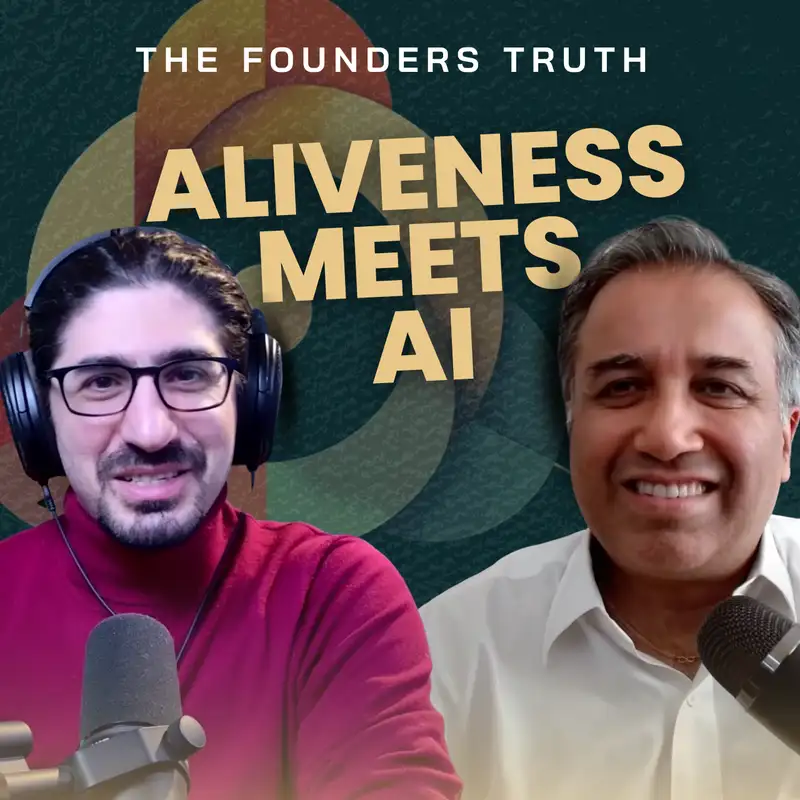
#08 From Real-Time Data to Real-Time Humanity: AI meets Aliveness with Satish Shenoy
Hello, unconventional founders, and welcome to The Founders Truth, a conversation with Carlo Mahfouz and guests. Episode eight continues with Satish Shenoy, business transformation expert with AI and automation, partner ecosystems builder, and author of Runaway Growth. As we explore why communication is the most underrated founder skill, how real time AI will rewrite what it means to run a company, and the one daily practice that teaches you to live with ambiguity rather than fight. This high quality episode was recorded today and edited using Riverside FM. It has made my life a breeze, especially with all the AI tools sitting right next to the editing tool.
Carlo Mahfouz:So please give it a try.
Satish Shenoy:You talk about destroying the barriers, right, between human and digital or synthetic. What I've seen in my experience is, you know, in speaking to all these people that are running AI initiatives at a lot of companies, etcetera, and are responsible for the outcomes, they're concerned about losing our humanity to AI, at least some of them are. So there's a tension between human and AI, right?
Carlo Mahfouz:Yeah, of course.
Satish Shenoy:And so how do you respond to that tension? What are they missing that could help them?
Carlo Mahfouz:It kind of, this is where it becomes really interesting. It kind of falls back on the second book to a certain extent, because why are they afraid of AI basically removing humanity? Because we've removed already humanity and the optimizations and how our team work. We forgot about what the culture creates. Like how important is the culture in our company as a driving factor, not the efficiency, not the optimization of the processes, not the optimization of the KPIs, not all of those things.
Carlo Mahfouz:And all AI is doing is closing the caps on those, to be honest. So I actually think it will create the opposite. Everyone is afraid that it will take out the humanity. I think it's going to allow humanity to surface even further because what's going to happen is now we can move all of these objectives and tracking and whatever so AI can handle these things. And now we're going to realize that even with AI taking all of these things, the team dynamics didn't get better.
Carlo Mahfouz:Like, right. So we're going to start looking for other ways and then we're going to start talking about other dimensions. And now there is a lot that we are creeping in. I mean, we had EQ for a while creeping in and kind of another metric, but now there is AQ, which is like awareness quotient and like another. And it's interesting that the dialogue is starting to shift in a different dimension, which is back to almost the actual component that I was talking about, which actually in book three, I call it aliveness.
Carlo Mahfouz:Like how we come back to aliveness, like how we can remove all of these efficiency optimizations, which AI is capturing, which AI at the end of the day is like really just optimizing what already exists and collapsing those things. So it's going to reduce the time from you being able to report on something to capture it because it can do that more real time. And that creates the opportunity and the window for all of these dimensions to surface. So that feels a little bit far fetched for a lot because a lot of people think that the current system we have is a good system. While actually the current system is broken, not again, because it's bad, like agile or any of the processes that we brought into our organization, they're not inherently bad.
Carlo Mahfouz:The problem is we just optimized against them, forgetting that that's not the only dimension that creates good teams. And that's the problem.
Satish Shenoy:Something you said caught my attention just now. You mentioned real time.
Carlo Mahfouz:Yeah.
Satish Shenoy:And I think in the book you said, if I recall correctly, you said technology will make everything real time.
Carlo Mahfouz:Yes. Is that accurate? Yeah. It
Satish Shenoy:is. Real time, what exactly, right? Is it real time decision making?
Carlo Mahfouz:Is it real time feedback? Is it real time culture that forms within teams? What real time? So actually that has been happening for a while now. It's just people probably didn't look at it from that sense.
Carlo Mahfouz:So like today, for example, it used to be that you knew only the information which was wound within the space that you lived in. But now you have information which lives outside of the space. So you can be anywhere and you get that. So that real time connection, even though there is distance, the distance was gone. We can take that even further.
Carlo Mahfouz:Today, have a lot of, if you want, lagging indicator, a lot of indicators which we usually measure after the fact to a certain extent. But those lagging indicators, even if you look at it in like customer reviews or something like that, they all come after the fact and they are all the snapshot in time of actually what has happened, not actually there right now, how is that interaction? So with AI, because its ability to reduce and crunch a lot of data almost in a much faster way, then we can actually get, you know, instead of getting this data points, you know, aggregate over one month, right? We can get it on a daily basis. Yeah.
Carlo Mahfouz:Right. And that's going to change almost everything. That's going to change what the customer experience is. Like now they're doing experiments and like even when you're scrolling on Netflix, for example, what is it showing you as you scroll through like in a dynamic way? And we cannot imagine to a certain extent what those things are because we actually didn't understand some of the things that we already had, like advertising today.
Carlo Mahfouz:What is it doing really? Crunching all of this data about you and showing you the relevant advertisement the second you scroll to it and you get to it. It's doing that. That's a real time kind. It's crunching so much information about you, what you scrolled yesterday, and what you would send in this chat, whatever, which is all over the place and giving you kind of a different outcome as a result of it, which is tangible because you are making your purchasing decisions based on what you see.
Carlo Mahfouz:So it's not like just theoretical. Fact, though, is very few people understood that that was happening and that capability used to be kind of enabled just for a few companies. Now, it will become more accessible to others.
Satish Shenoy:So this whole idea of personalization at scale, which we talk about in terms of customer experience. For example, just as an example this real time nature, it's not just personalization at scale, personalization at scale in real time. Yeah, exactly. Yeah, right.
Carlo Mahfouz:But imagine that in measuring company performance as well, not only customer experience, but company performance in real time. You know, you do your finance, how quickly they usually, every quarter you get like a report. What if that report is live? Like how you are able to see that and when there is, for example, a pandemic happening, how you can see those things changing life and how based on that information, what other decisions that you can do that you probably couldn't, or you couldn't even know about because the report came like three months after. Like imagine that.
Carlo Mahfouz:I think the problem is that a lot of people think that that's almost impossible as such, don't regard what is the possibility as a result.
Satish Shenoy:Yeah, yeah. That makes sense. Now, I was thinking about, yesterday I was listening to something you had described about the three books. You know, and you had described each of the three books to me because I'd asked you what was in the three books. And I got thinking about what's that connective tissue that connects the three books?
Satish Shenoy:Right? Is there a single insight? There's a way to do that, is there a single insight or principle that kind of ties the three books together, the trilogy? Yeah.
Carlo Mahfouz:That's actually the reality of the matter is that three books are all the same book, except the context is changing in each one of them. What I mean about that in each one of the book, we're collapsing or dissolving a barrier or removing from the equation. And that happens actually three times. So we are first removing you out of the way as a founder to really be the founder you need to be. And then second, we're removing the team from being individuals and become a team as a unit, which is cohesive, like almost merging you and the team as one and removing those barriers between you and the team, those certain or the team members within that sphere.
Carlo Mahfouz:And then lastly, you not necessarily you, but like your organization or your company in the context of how it leverages technology and culture, where they are no longer a separate components that you are dealing with or etcetera, but they are kind of interweaving into each other. So in each one we are trying to dissolve the barriers which are created, which make it feel as if you are managing different things, yet they are all interconnected.
Satish Shenoy:It's funny, when you're describing that, I was thinking of the traditional ways in which we talk about driving performance with people, process, technology. Yeah. What you're doing in some ways is to bring all those three elements together, right? People, process, and technology.
Carlo Mahfouz:Pretty much. A way, and like, I think the whole premise, honestly, about the founders' truth is that the foundations hold a lot of value and we should be almost optimizing for them. And once you start looking at the foundations, whether the foundations of who you are, the foundations of the team that need to exist, the foundations of society, you realize that they are not separate from each other. And actually, you cannot even recognize the separation. Like almost the separation completely dissolves as a function of that.
Carlo Mahfouz:Like right now, where technology is in this dialogue right now. It's in the screen, the camera that's watching you, but we no longer think about these things. Like it's almost just inherently like, yeah, we're having a conversation remotely and everything is just working. But there is so much technology, there is so much actually change in behavior for us even to accept that this is a format where not being in person, we're still able to communicate and have a meaningful conversation. Like that's fascinating.
Carlo Mahfouz:And a lot of these things we've kind of forgot about or like no longer paid attention to because they are given, and that's the beauty of it. They become so given that they completely disappear from our attention.
Satish Shenoy:Very interesting. Yes. So one of the other things you had mentioned to me was that writing helped you see through the BS we have been preaching. Yeah. What's the biggest piece of, you know, advice for either the founder or their startup that has been kind of the normal that you now see as BS based on?
Carlo Mahfouz:In the context of how they think through problems or in the, yeah? What's the other one?
Satish Shenoy:What were you going to say?
Carlo Mahfouz:I was thinking because you mentioned writing and like how writing allows you to express or see yourself, and I think that's very powerful. But the reason that's very powerful because we underestimate the power of communication, almost the power of language that has on us in a way. It kind of ties back to a few things, I think. When you think about something when you say something, and then when you write something, and then when you read and hear what you write, it's all different experiences. And I believe in a lot of ways, what we take for granted a lot of the times is actually that we, because we've learned the language that actually we can communicate in it, which I don't think it's true.
Carlo Mahfouz:There is a level of complexity that it's inherited in it that we've completely ignored and we actually don't even pay attention to. And that's why I think first off, everyone should be writing, not necessarily for the sake of writing, actually writing and even visualizing because visualizing something in a drawing and then writing it, again, they're all different mediums and some people can do one medium better than the other for the most part. But if a founder cannot communicate what they are trying to do, it's like basically, I don't know if you gave me this example, I think yesterday, if you have a data scientist, which basically couldn't, you know, or a scientist in general, which has amazing ideas, but that could not communicate those ideas, then what's the point of those ideas? That's right. Like that's the reality is.
Carlo Mahfouz:So in a lot of ways, and actually there is a whole chapter in the first book about communication and like speaking, because it's one of the first thing that represent us as a human. Like when anything that comes out of us is really how we communicate. And you couldn't imagine how many times things go just crazy bad, mostly because of communication issues, not because people are really actually disagreeing or have, but people use different syntax, different taxonomy based on their experience, how they shape it, based on their beliefs, like all of those things, based even on the culture and how they approach, they will be more aggressive or less aggressive or more, you know, collective in how they share, you know, problems or how they describe the problem. There is so many variation, which we are like, Oh no, there is only one standard, and we just talk that standard and everything will be fine, which is, I mean, extreme like, again, absurd almost in how we approach it. And that's why I believe, you know, kind of honing in on those things.
Carlo Mahfouz:And today, AI can help you so much. Like, forget about AI for a tool to give you answers, to be honest, like scratch that from you. Use it as a tool to learn. Use it as a tool to shape ideas in different formats and different ways and different ways of understanding them. You know, that give me this idea and a joke, give me this idea and a table, give me this idea and like, know, describe to a five years old and not accept the answer.
Carlo Mahfouz:But actually it kind of nudges you to start able to see that type of thinking, see an angle that you didn't see, not to basically, again, this is not give me the answer kind of approach. This is more of like open my mind on this approach, what it creates in a way. And though there's so much opportunity there, and I do believe today, I think founders are coming ill prepared because they assume, okay, I have a cool idea, then the cool idea should sell itself, which honestly is, I think, one of the BSs for the most part because anyone knows 90% of the time what sells is the story behind the idea, not necessarily the idea itself, which as well, I think, has its own downfalls because we end up starting optimizing for the story and forgetting about the essence. Like and that's where we start creating more attention in that dialogue. We end up with a lot of people good at the storytelling, but they have no essence behind them.
Satish Shenoy:That's a good point. Yeah. So so the trilogy is for a lot of founders. I can see is is there a different you know, is there a are there different types of founders that the trilogy is for? If there's a type of founder that won't resonate with the approach in the trilogy, who would that be?
Satish Shenoy:Is that one?
Carlo Mahfouz:I think there definitely is. So I don't think this is for everyone, to be honest. And, you know, part of, you know, the new version of Reality Check focusing on founders is because, I've realized that the ideas that I'm suggesting is, especially in their paradoxical nature and the level of rigor that they require to kind of move through, require this certain type of person. And when I am defining founders, I'm not defining them probably just the people who are building companies or doing startups. I'm defining them which basically inherently have three characteristics, which shape the three books, which are wrestling with ambiguity and know what that means to a certain extent, even if they don't have it all the time, have this level of absurdity in their approach up to the point where they feel sometimes lonely in their ideas, or like kind of they are so against the grain that things don't work.
Carlo Mahfouz:And like they're working against the system almost and aliveness, that they have a passion that is burning so hot that it almost feels ridiculous not to do what they're doing. So in those three aspects, that's how I define a founder. And as a consequence of that, I do believe a founder could be someone who's working, you know, in corporate innovation or someone working in any corporation. Does not necessarily mean that they're starting their company today, but they are building or creating new ideas and shaping them in a bigger context. So it actually has a lot of different dimensions on what that look like.
Carlo Mahfouz:And I think that's important to highlight here. So it's not for the person who has I think, you know, if someone is really just relying on data, data and validation and data and the clarity, and I need every single decision to be measured on, I think it's not for you. You're going to struggle a lot with a lot of the ideas that are being discussed and almost reject them off the bat.
Satish Shenoy:So that last response reminded me, you know, it doesn't have to be a founder per se in the traditional sense of the word. We've all been part of corporate structures and so on. Yeah. But we are still founders in our own right. You know, when you were writing this trilogy, I bet there were some assumptions you made, right, given so what assumption of yourself as a founder did you have to break when you wrote this trilogy?
Carlo Mahfouz:Oof. I think, know, the thing is I'm always breaking assumptions as I go up to the point where sometimes I don't even notice it. But probably one of the graver ones, especially since I launched Reality Check and along the is something I mentioned before is like how easy to get kind of seduced by jumping too far ahead. Like it's so easy to not focus on the foundational elements you need to succeed and focus on the shiny new thing that you've created or the shiny new thing, which you spend so much time, almost omitting completely what it requires as foundational elements around you. So I would say create an ecosystem that found it to be successful.
Carlo Mahfouz:And part of writing this is really just shifting the attention almost to those elements, whether in I think in new reality check, capture that. What I'm introducing actually in the new revised new edition is actually how to map it. Like, because I believe every chapter contain that trajectory, but what most people took from it is like, what are the lessons? Actually, actually don't I don't care too much about the lessons. What I wanted you to do is plot your own journey almost based on what you read.
Carlo Mahfouz:And there is going to be now the tool, which is going to be with every chapter, which is going to help you to actually plot your own journey almost to take what the essence of each chapter is trying to convey.
Satish Shenoy:So I can personalize it almost.
Carlo Mahfouz:Yeah. To personalize it. Exactly. Because I think that's the biggest value there is not going and say, Oh, I gave a story about this founder, how they basically went about, you know, and they succeeded. What the essence of it is more of the principle behind it.
Carlo Mahfouz:And I want you to apply this principle to you. So there is going to be now a way, actually, you know, a quadrant, which allows you to map each chapter through, and then you can actually see it live. And I will be providing an example of mine so you can easily, like, look and kind of compare. Got it.
Satish Shenoy:Yesterday, I was thinking, Carlo, after hearing the description, you know, if somebody reads all three books, right, everybody has challenges with time and bandwidth and so on. And I was thinking about this myself. I'll I'll respond to the question for myself, and then I'll ask you the if someone reads all three books, right Yeah. But they have the bandwidth to apply one of them. Yeah.
Satish Shenoy:Which should it be and why? Okay. And I was I I I'm asking you the question, but I was thinking about this myself. I was like, I would think that as selfish as it sounds Yeah. If you don't fix yourself first, almost not fix, but you know what I mean.
Satish Shenoy:Work on yourself. Everything else in some ways doesn't matter. True. That's how I was thinking about it. Right?
Satish Shenoy:True.
Carlo Mahfouz:Yeah. Would you Interestingly, I have thought about that problem. And the answer is this. You actually need only to read one chapter from any of the books. And the way to decide which chapter is, and I don't care actually if it's from the first book or the second book or the third book, It's more of what is the biggest challenge you feed yourself now you are facing, right?
Carlo Mahfouz:And go to a chapter which is speaking to that. Because, and I'll tell you how that's, in for example, in Reality Check, the book starts with, it's about you as an individual, but it starts with more analytical to creative, to spiritual almost. And the challenges on where you actually take you through that. And even the experiences are shared. So actually each chapter can get you to where you need to go.
Carlo Mahfouz:You don't need to read all of it. It's more so where are you? So the other thing is, which I always find fascinating is if the chapter does not meet you where you are now, it's going to be very hard to go and execute on like the mapping and the work that requires. So if in essence, what I want the reader or the founder, whoever kind of capture or any of those book is actually to go and see, like today I'm facing this, where do I find myself closest and then start there almost. And ideally, that will be kind of a way to Because for me, and I've been discussing that, I've realized actually even going through one track in one of the chapters, going through that properly will give you so much better results than trying to cover the whole book.
Carlo Mahfouz:So, I actually don't recommend to read all the books actually. For the most part, I would say read one chapter and like go and map the exercise of that one chapter and actually stay in that one chapter until and I'm going to basically, as well as part of that tool, I'm going to tell you when you can exit that chapter, like when you get to a point where you can leave that chapter. And I find that I'm hoping to find. We will see how that you know, we'll see how the reactions of the readers will be Yeah. Will help them across because I completely recognize no one has time.
Carlo Mahfouz:The bandwidth for time and attention is much, much less. But what I always find easy, if it's something I'm already doing today, it's much easy for me. Then I'm just filling in the blanks, not necessarily trying to create something where I'm not. So today, I'm managing a team and I'm struggling with the teams. I'm start there.
Carlo Mahfouz:Today, I'm in a you know, I'm managing an organization and I'm having struggles like, you know, addressing markets or divisions or like innovation or like, then start in that one or doing digital transformation then start in the third book. And now, now I'm spending more time and like, you know, being introspective of who I need to be, and I have an analytical mind or a creative mind, then start with the first book and then select a chapter which mirrors to that.
Satish Shenoy:Yeah, makes sense. Makes lot of sense. I didn't think of the, you know, bringing it down to the chapter. Practically, it makes a lot of sense, actually. So I know it's almost an hour since we started, and I can't believe that time has flown by so quickly.
Satish Shenoy:So let's bring it down to something very practical. Right? Mhmm. You know, I know the books are coming. Until that happens, what is something that, from a daily practice standpoint Mhmm.
Satish Shenoy:That really captures the essence of the philosophy of your trilogy that somebody can implement tangible, something tangible that somebody can implement starting today, starting tomorrow while they wait for your books?
Carlo Mahfouz:So let's give a very so a very, very tangible one, which actually speaks around this ambiguity and clarity dimension because I think it's gonna be coming you know, it's coming in the first book and it's, the most accessible coming soon. I think leave every conversation where you allow someone else an exit. What I mean is don't never and take it on your behalf and then do it for yourself too, where no matter how much you're judging yourself or the situation or making decision, give someone the space to kind of leave from. And by doing so, you're kind of starting to marry this ambiguity because by allowing someone and that could be, you're having a difficult conversation with someone, which is you're disagreeing with, but always, even it could be yourself, like having the conversation with yourself and judging yourself very harshly. Give yourself almost the space or the room to leave the door.
Carlo Mahfouz:Kind of leave a small door open. And that you don't know what the outcome of it will that create, but never create it as an absolute. And that will start giving you a sense of a little bit when we talk, because there is a level of risk, there is a level of uncertainty by doing so. There is a level of, if you want, like not very extreme decisive decision making, there is a level of all of those. There is a level of fear in it.
Carlo Mahfouz:But even with all of those things, try to incorporate that in anything you do, in the home, at work, in anything you do. And that's going to start giving you a feeling of this tension of clarity and ambiguity living in each other.
Satish Shenoy:So I'll bring it in a practical sense. Used to always tell my wife, right, so let's say you ask somebody for something. Yeah. Or even you ask them for, Hey, you want to come over for dinner? Or whatever, right?
Satish Shenoy:Let's make this very practical.
Carlo Mahfouz:Yeah, yeah,
Satish Shenoy:yeah. I would tell, you know, my wife and I have always this conversation. I would tell her that we should always give them an out. When you are
Carlo Mahfouz:100%. Give them a way out. That's actually a much better way of even expressing. Give them a way out, and give yourself a way out. Always give yourself or others or situations a way out.
Satish Shenoy:Yeah. Beautifully said. Thank you
Carlo Mahfouz:so much for listening to The Founders Truth, a space for opening your mind to new possibilities and thinking. One question to reflect on is, how are you using AI today? Is it for answers or expanding your thinking?
Creators and Guests